
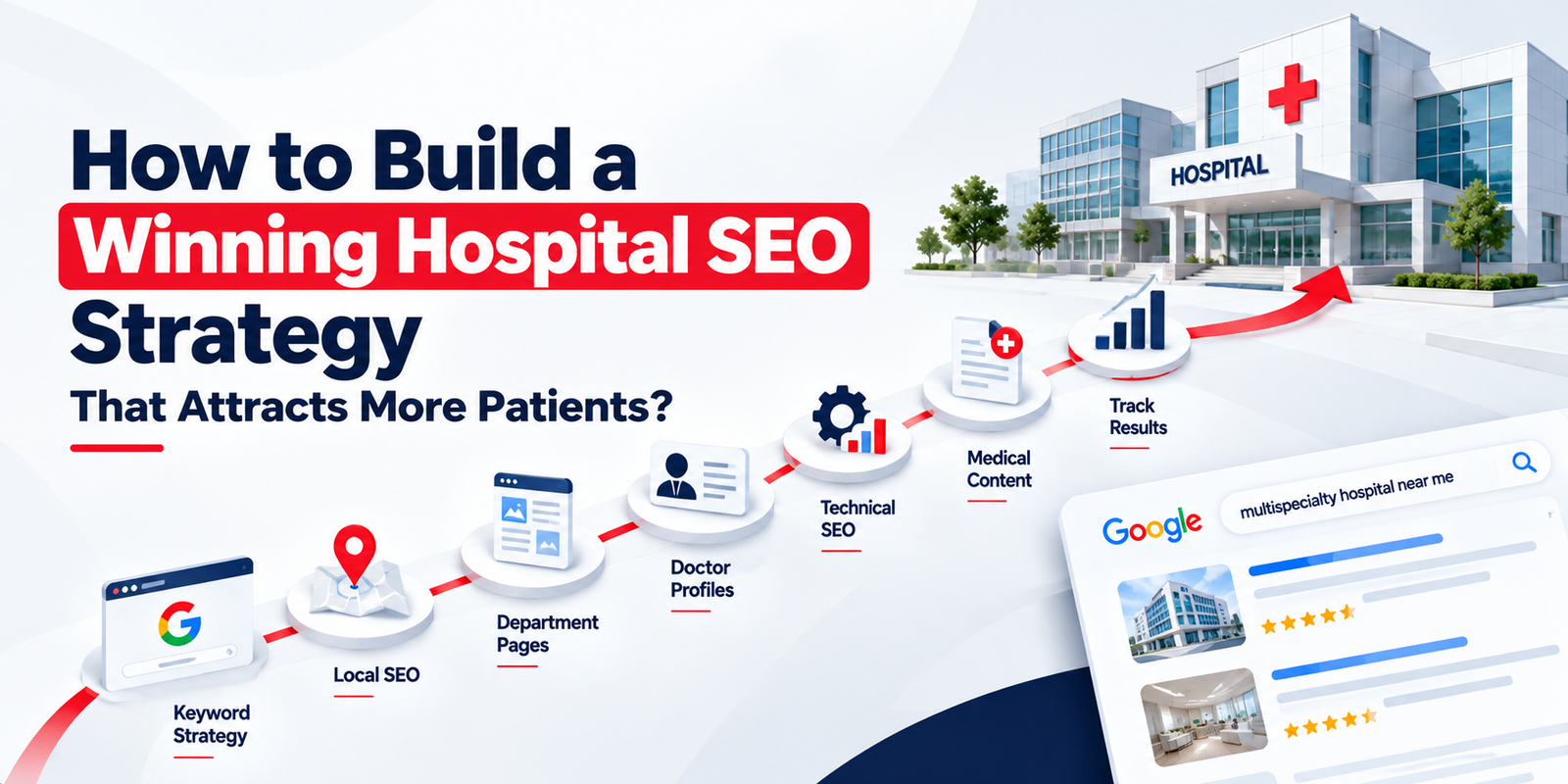
A hospital can offer experienced doctors, advanced facilities and multiple medical specialties, yet still struggle to appear when potential patients search on Google. The problem is often not the quality of healthcare services. It is that the hospital’s website does not clearly communicate those services to search engines and prospective patients.
Hospital SEO helps address this gap. But successful SEO for a hospital requires more than adding keywords to its homepage or publishing a few medical blogs.
A winning hospital SEO strategy connects the hospital’s departments, doctors, treatments and locations with the searches people make when looking for healthcare services. It also makes it easier for those visitors to find trustworthy information and request an appointment.
In this guide, we’ll explain how to plan, implement and measure hospital SEO in a practical way.
What Is Hospital SEO?
Hospital SEO (Search Engine Optimization) is the process of improving a hospital’s website and online presence so that its medical services, departments, doctors and locations can become more visible in relevant organic search results.
For example, a hospital offering orthopedic surgery may want its orthopedic department page to appear for relevant searches in its city. A multispecialty hospital may also need separate visibility for cardiology, gynecology, neurology and other departments.
The goal is not simply to increase website traffic. It is to attract people looking for services the hospital actually provides and help them take the appropriate next step.
Step 1: Audit Your Hospital’s Existing Search Visibility
Before making SEO changes, understand where your hospital stands today.
Start with Google Search Console and your website analytics. Identify which pages already receive organic search traffic, which medical services generate search impressions and which important department pages have little or no visibility.
Questions to answer during the audit
- Are the homepage and major department pages indexed by Google?
- Which searches currently bring visitors to the website?
- Do individual departments have dedicated pages?
- Are doctor profiles accessible and up to date?
- Are important pages difficult to use on mobile devices?
- Do visitors have a clear way to request an appointment?
- Are there duplicate or outdated pages competing for the same searches?
Also review the search results for your hospital’s name and priority services. Look at which types of pages appear for those searches: hospital homepages, department pages, directories or individual doctor profiles.
Action: Create a simple audit sheet listing each important page, its target search intent, current performance and the improvements required.
Step 2: Choose the Right Departments and Keywords
Not every hospital department needs the same SEO investment.
A multispecialty hospital may have dozens of services, but some departments may have greater search demand, stronger growth objectives or more immediate capacity for appointments.
Begin by identifying priority departments in consultation with hospital management and the relevant medical teams.
Map keywords to the right pages
Keyword research should distinguish between people looking for a healthcare provider and people researching medical information.
| Search intent | Example search | Recommended page |
|---|---|---|
| Hospital discovery | Multispecialty hospital in Varanasi | Hospital homepage or relevant location page |
| Department search | Orthopedic hospital in Varanasi | Orthopedic department page |
| Specialist search | Cardiologist in Varanasi | Relevant specialist or department page |
| Service search | Knee replacement hospital in Varanasi | Relevant service page, if offered |
| Information search | What happens during an orthopedic consultation? | Medically reviewed educational article |
These are illustrative search examples, not verified keyword-volume estimates.
Avoid targeting the same primary keyword on several similar pages. Each important page should have a clear purpose and a distinct search intent.
Action: Build a keyword-to-page map for the hospital’s priority specialties before rewriting website content.
Step 3: Create a Search-Friendly Hospital Website Structure
Hospital websites often grow over time without a consistent structure. New departments, doctors and treatment pages are added, but visitors may struggle to understand how everything connects.
A clear website structure makes it easier for patients to navigate and helps search engines discover related information.
Recommended hospital website hierarchy
- Homepage: Hospital overview, locations and major specialties
- Department pages: Cardiology, orthopedics, neurology and other available specialties
- Service pages: Important treatments or procedures genuinely offered
- Doctor profiles: Qualifications, specialties and consultation information
- Location pages: Information for each hospital branch, where applicable
- Educational articles: Relevant patient questions connected to departments
- Appointments and contact: Clear enquiry and booking options
For example, an orthopedic department page might link to the orthopedic doctors, available services and relevant educational resources. Those related pages should also provide a logical route back to the department.
Avoid creating multiple pages with nearly identical content simply to target small keyword variations.
Action: Make sure every major department can be reached easily from the hospital’s navigation and is connected to its relevant doctors and services.
Step 4: Optimize Department Pages Before Publishing More Blogs
Department pages are among the most important assets in hospital SEO because they connect directly to medical services and potential appointment enquiries.
Yet many hospital websites have department pages containing only a short paragraph and a list of treatments.
Instead, each page should help patients understand the department and the care available.
What an effective hospital department page should include
- A clear H1 describing the department
- An introduction explaining the services offered
- Information about relevant consultations and facilities
- Available doctors with accurate professional credentials
- Location and consultation details
- Links to related services or educational information
- A clear appointment or enquiry option
Use descriptive page titles and headings, but avoid repetitive phrases such as “best cardiology hospital” throughout the content.
Hospital pages should accurately represent the services, professionals and facilities available at that location.
Action: Select three priority department pages and improve their content, headings, navigation and appointment experience before expanding the SEO project.
Step 5: Make Doctor Profiles Part of Your SEO Strategy
Doctors are an important part of a hospital’s online identity. Patients frequently search for specialists by medical field, location and sometimes by name.
Well-maintained doctor profiles help visitors understand who provides care at the hospital.
Useful information for doctor profile pages
- Doctor’s full professional name
- Verified qualifications and relevant credentials
- Medical specialty and areas of practice
- Hospital affiliation and consultation location
- Accurate appointment information
- Links to the relevant department and services
Avoid creating profiles with copied biographies or claims that cannot be verified.
When doctors practice at more than one location, ensure the profile accurately explains where consultations are available.
Action: Review doctor profiles regularly, especially when consultation schedules or hospital affiliations change.
Step 6: Strengthen Local SEO and Google Maps Visibility
Local search is essential for many hospitals because patients often consider distance, accessibility and available services when choosing where to seek care.
A search such as “hospital near me” may display Google Maps results alongside organic website listings.
Hospitals should maintain an accurate Google Business Profile for each eligible location.
Hospital local SEO checklist
- Use the hospital’s official business name.
- Maintain the correct address, phone number and opening hours.
- Select appropriate business categories.
- Keep website and appointment links accurate.
- Add genuine photographs of the hospital and its facilities.
- Ensure the website displays consistent location information.
- Respond professionally to reviews without revealing patient information.
For hospitals operating multiple branches, create useful location-specific website pages that describe the services available at each facility.
Remember that local rankings depend on factors including relevance, distance and prominence. No SEO agency can guarantee a particular position in Google Maps.
Action: Audit the hospital’s Google Business Profile and compare its information with the website before making further local SEO changes.
Step 7: Fix Technical SEO Issues Affecting Important Pages
Technical SEO ensures that search engines can access and interpret the hospital’s website while visitors receive a reliable browsing experience.
Some of the most important checks include:
- Indexing: Confirm that priority department and location pages are eligible to appear in search results.
- Canonical tags: Identify the preferred URL where duplicate or near-duplicate pages exist.
- Mobile usability: Ensure navigation, text, forms and buttons work properly on smartphones.
- Website performance: Optimize images and unnecessary scripts that slow down pages.
- Internal linking: Connect related departments, doctors and services.
- Structured data: Use valid, relevant markup that accurately reflects visible website information.
- Security: Use HTTPS and appropriate safeguards for enquiry and appointment systems.
For larger hospital websites, technical audits should also look for orphan pages, broken internal links, outdated redirects and duplicate URLs created by the content management system.
Action: Prioritize technical fixes that affect important service pages rather than spending time on low-impact warnings.
Step 8: Build Medical Content Around Your Hospital’s Expertise
Educational content can support hospital SEO when it answers genuine patient questions and connects naturally to the hospital’s medical specialties.
For example, an orthopedic department could publish an article explaining when someone should consult an orthopedic specialist. The article could then link to the hospital’s orthopedic department page for readers who want information about available consultations.
Medical content requires particular care because inaccurate information can influence health decisions.
Healthcare content quality guidelines
- Choose topics related to services the hospital genuinely offers.
- Use appropriately qualified medical authors or reviewers.
- Explain medical terms in language patients can understand.
- Keep treatment information balanced and accurate.
- Update content when medical guidance changes.
- Avoid guaranteed outcomes or exaggerated claims.
- Make it clear when information is educational rather than personalized medical advice.
Instead of publishing many unrelated articles, organize content around the hospital’s priority departments.
Action: For each priority specialty, identify a small group of useful patient questions and connect the resulting articles to the relevant service pages.
Step 9: Measure Rankings, Organic Enquiries and Department Performance
A hospital SEO strategy should be evaluated through meaningful outcomes, not just ranking reports.
Higher organic traffic can be encouraging, but it does not necessarily mean the hospital is receiving more relevant enquiries.
Use Google Search Console to review search queries, clicks, impressions and landing page visibility. Use appropriately configured analytics to understand how visitors interact with important pages.
Hospital SEO metrics worth tracking
- Organic clicks to department and location pages
- Search visibility for priority specialties
- Relevant calls and appointment enquiries
- Conversion rates on important landing pages
- Google Business Profile interactions
- Indexing and technical website issues
- Changes in organic performance by department
Where legally appropriate, hospitals can also assess how enquiries progress into scheduled appointments using privacy-conscious internal reporting.
Do not send sensitive patient information, diagnoses or treatment details to advertising and analytics platforms through ordinary marketing tracking.
Action: Create a monthly SEO report that shows both search visibility and relevant enquiry performance for the hospital’s priority departments.
What Does a Practical 90-Day Hospital SEO Plan Look Like?
Hospital SEO is an ongoing process, but a 90-day plan can help teams establish priorities and begin implementation.
| Timeline | Primary activities | Expected deliverables |
|---|---|---|
| Days 1–30 | Website audit, keyword research, department prioritization, indexing checks and local SEO review | SEO audit, keyword map and prioritized action plan |
| Days 31–60 | Department page optimization, doctor profile improvements, technical fixes and internal linking | Improved priority pages and resolved high-impact technical issues |
| Days 61–90 | Medical content development, further local optimization, conversion review and performance reporting | Supporting content, updated reporting and next-phase priorities |
This is an implementation framework, not a promise of first-page rankings within 90 days. SEO outcomes depend on competition, website condition, search demand and ongoing work.
Common Hospital SEO Mistakes to Avoid
Even well-established hospitals can limit their search visibility through avoidable mistakes.
- Targeting every specialty on the homepage: Important departments need their own useful pages.
- Publishing content without a clear purpose: Every article should answer a real question or support a relevant service.
- Using duplicate department content: Similar pages should provide genuinely distinct information.
- Ignoring doctor profiles: Incomplete or outdated profiles can create confusion for patients.
- Overlooking local SEO: Incorrect location and contact details can affect patient discovery.
- Measuring only keyword rankings: Relevant enquiries and patient experience also matter.
- Making unsupported medical claims: Accuracy and professional responsibility should always come first.
When Should a Hospital Work With an SEO Agency?
Managing SEO for a multispecialty hospital can involve coordinating department pages, doctor information, technical website improvements, medical content and local search visibility.
A specialized marketing partner can help organize these activities into a measurable plan.
When choosing an agency, ask how it handles department-level keyword research, healthcare content accuracy, technical SEO, local search and enquiry reporting.
PayPerCliq is a digital marketing agency in Varanasi with experience working with hospitals, doctors and healthcare organizations.
Our hospital digital marketing services help healthcare organizations plan and manage SEO alongside other relevant digital marketing channels.
For a broader understanding of hospital marketing, read our related guide on digital marketing strategies for multispecialty hospitals.
You can also explore our healthcare SEO guide and healthcare digital marketing services.
Frequently Asked Questions About Hospital SEO
What is the most important part of hospital SEO?
There is no single factor that guarantees success. However, a clear website structure with accurate department pages, reliable doctor information, strong technical foundations and relevant local visibility provides an important starting point.
How can hospitals rank higher on Google?
Hospitals can improve their organic search performance by matching relevant searches to useful department and service pages, fixing technical problems, maintaining accurate local information and publishing trustworthy medical content.
How long does hospital SEO take to work?
SEO timelines vary according to competition, website condition and existing search visibility. Some improvements may become visible relatively quickly, while competitive search growth often requires sustained work over several months.
Should hospitals create separate SEO pages for each department?
Major departments generally benefit from dedicated pages that explain available services, specialists and appointment information. These pages should contain useful, distinct information rather than repeated text.
Can hospital SEO generate patient enquiries?
SEO can help hospitals attract people searching for relevant healthcare services. When visitors reach useful pages with clear contact and appointment options, that visibility can contribute to patient enquiries. Results vary and should be measured appropriately.
Conclusion
A winning hospital SEO strategy starts with the right priorities: understand patient search intent, optimize important departments, maintain accurate doctor and location information, and build a website that is easy to navigate.
Technical SEO, useful medical content and local search visibility then support those foundations.
Most importantly, measure whether organic search is helping relevant patients discover the hospital’s services and make enquiries—not simply whether keyword positions have changed.
If your hospital needs a structured SEO and digital marketing plan, explore PayPerCliq’s hospital digital marketing services or contact our team on WhatsApp.
